







Abstract
1. Introduction
In 1964 the first high-speed train started operating in Japan [1]. Since then, this type of rail system has made great progress mainly in Japan, France, Germany, Italy, Britain, and lately in China. It is mandatory for rail systems to have a reliable and safe automatic train control (ATC) system.
The ATC system plays a vital role in the rail system to ensure safety and efficiency. ATC systems have been studied for many years [2,3], from the earlier track-based train control (TBTC) systems to the modern communication-based train control (CBTC) systems [4–6]. A CBTC system consists of automatic train supervision (ATS), automatic train operation (ATO), automatic train protection (ATP), zone controller (ZC), data communication system (DCS), database storage unit (DSU) and computer interlocking (CI).
Intelligent control strategies emerged in the 1980s to satisfy such real-time multi-objective dynamic operational requirements [7,8]. PID control, genetic algorithms [9–11], fuzzy logic [12–14], expert systems [15] and artificial neural networks [16,17] have been used to improve the safety, efficiency and accuracy of train's profile tracking [18]. Recently, iterative learning control and hybrid control approaches have been proposed [19–21]. ATO algorithms for high-speed trains are now also attracting more and more attentions [22, 23].
The method of combining the
Introduced by Richalet and ADERSA, predictive function control (PFC) is efficiently applied in industrial systems, especially in fast systems [32]. Generalized predicative control (GPC) [33], dynamic matrix control (DMC) [34], PFC [35,36] and model predictive heuristic control (MPHC) [37] follow the same principles, but differ in the model structure and computational complexity. However, DMC and GPC need high computational complexity due to matrix computations and inversions. The control command of PFC does not minimize a cost function. PFC avoids high dimensional matrix computations and inversions, which can reduce the computational time [38], and this is especially important for a fast dynamic system. The robustness in PFC controllers is also important for time varying dynamical systems such as CBTC systems.
A CBTC system is an automatic train control system using bidirectional train-ground communications to transmit train status and control commands to ensure the safe operation of trains. The train-ground data should be transferred accurately, reliably and in real time. However, transmission delays and packet drops are inevitable in train-ground transmission which could result in unnecessary traction, brakes or even emergency brakes of trains, loss of line capacity and passenger dissatisfaction. So we need to develop control algorithms to improve the system performances under transmission delays and packet drops. In this paper, we propose a PFC scheme based on a mixed
The PFC based on a mixed
This paper is organized as follows. In Section II we model the communication-based train control (CBTC) system and describe the problem of the PFC based on a mixed
2. Communication-based Train Control System Design
2.1 System Description
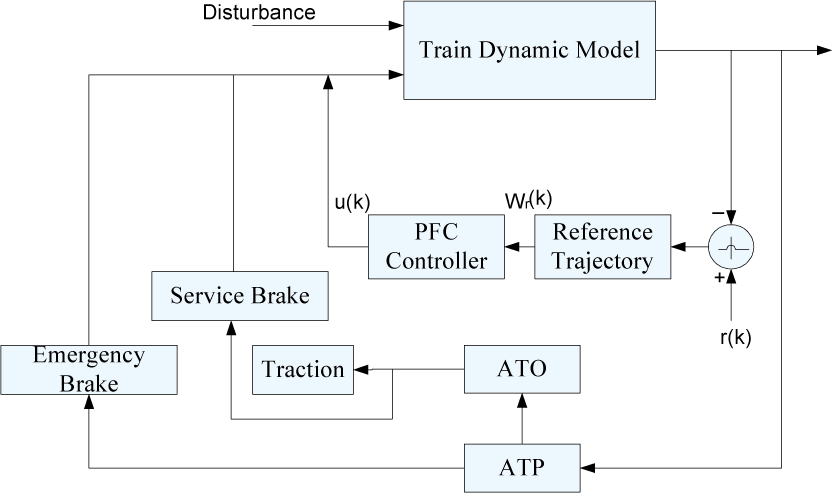
The train control model in CBTC systems is presented in Fig.1. According to the dynamic of communication-based train, the train's state space equation can be written as

where
Eq. (1) can be rewritten as

where

2.2 PFC Based on a Mixed H2/H∞ as a CBTC Controller
Kuntze and Richalet proposed the PFC in [32].
1) Referenced profile: the referenced profile of PFC is given by

where
2) Base Function: the future control variable of PFC is associated with specific base functions which are set according to the process nature and set points, namely the linear combination of the base functions. The base function may be a step function, ramp function, exponential function, etc. The base function makes the controller's output more regular and improves the rapidity of the system response. Both the base function and its sampled value can be computed offline. A little linear weighting coefficient is optimized to reduce the computational complexity. The control variable of PFC is

where μ

The parameters of the PFC controller can influence the performance of the system.
3) Feedback correction: in order to overcome the imprecise of the model, we introduce feedback correction. Feedback correction of the predicted output is based on the error between the actual y(k) and the predicted output

where

If disturbance rejection γ > 0 exists, then

where

For given

Adding (2) and (5), we can get

We assume that the disturbance is bounded with

where w̄

Consider a quadratic function


Consider the sum of (11) from

Assuming that


where

This is an upper bound on the mixed
Theorem 2.1 Consider the system defined in (2). Then, if the linear combination of base functions

γ2 is a parameter that can be tuned using simulations, α2is the measure of the contribution of the
Condition (14) might be considered as the normalized mixed objective function. This is a more natural combination of the control objectives since it emphasizes the trade-off between the normalized
3. Simulations and Discussions
In our simulation, we consider the discrete-time model of a CBTC given by (2), with sampling time

The velocity tracking curve of the train (the predictive lengths H1=8, H2=9).

The position tracking curve of the train (the predictive lengths H1=8, H2=9).

The velocity tracking curve of the train (the predictive lengths H1=18, H2=35).

The position tracking curve of the train (the predictive lengths H1=18, H2=35).

The velocity tracking curve with disturbance of the train (the predictive lengths H1=8, H2=9)

The velocity tracking curve with disturbance of the train (the predictive lengths H1=18, H2=35)
Fig. 6 and Fig. 7 give the results of the velocity tracking curve of the train with disturbance under different prediction lengths. The simulation results show that the system can reach stability quickly under the disturbance, meaning that the proposed method has good robustness.
4. Conclusion and Future Work
In CBTC systems, it is very important to improve the controller of ATC systems to mitigate the impact of transmission delays and packet drops. In this paper, we proposed a novel PFC based on a mixed