We investigate secure communications in untrusted energy harvesting relay networks, where the amplify-and-forward relay is an energy constrained node powered by the received radio frequency signals, and try to unauthorizedly decode the confidential information from the source. The secrecy outage probability and connection outage probability are respectively derived in closed-form to evaluate the security and reliability for three energy harvesting strategies, for example, time switching relaying strategy, power splitting relaying strategy, and ideal relaying receiver strategy. Subsequently, the effective secrecy throughput is conducted to characterize the overall efficiency, and the asymptotic analysis of the secrecy throughput is given to determine the optimal energy harvesting strategies in different operating regimes. Furthermore, in order to achieve the optimal effective secrecy throughput performance, a switching threshold between time switching relaying and power splitting relaying is designed. Numerical results verify the accuracy of the analytical expressions and reveal that the effective secrecy throughput of the system can be effectively promoted by the threshold switching energy harvesting strategy.
With rapid advance in wireless technologies and proliferation in relevant services and applications, the problem of energy depletion has received significantly attention recently. Simultaneous wireless information and power transfer (SWIPT) has become an upsurge research for providing perpetual energy source and prolonging the lifetime of the energy constrained wireless devices, since it can sustainably harvest energy from radio frequency signals.1–3
The theoretical foundations of SWIPT technology over the wireless channels were laid in Varshney4 and Grover and Sahai,5 in which the authors proposed the idea of simultaneous information and power transmission and characterized the tradeoff between capacity and power delivered. Subsequently, the work in Varshney4 and Grover and Sahai5 was extended to wireless cooperative networks6–8 and cognitive relay networks,9 where the relay is energy constrained node. Based on time switching and power splitting relaying (PSR) protocols, Nasir et al.6 studied the throughput performance of an amplify-and-forward (AF) energy harvesting relay network. In Zhong et al.,7 which focused on the full-duplex relaying system, the authors pointed out that throughput could substantially boost compared to the traditional half-duplex relaying protocol. Moreover, maximizing the achievable rate in multiple antenna energy harvesting relay networks based on power splitting technique was considered in Zhou et al.8 The outage probability was derived for the underlay cooperative cognitive radio networks with SWIPT in Yang et al.9
On the other hand, due to the inherent openness of the wireless transmission medium, the issues of privacy and security are of utmost concern for wireless SWIPT cooperative networks. Different from the traditionally cryptographic approach, deploying secret keys in upper layers, physical layer security exploits the features of wireless channels, such as fading and noise, to confound the eavesdropper. Over the years, substantial research efforts have been made to address the problem of physical layer security in trusted relay networks with SWIPT. However, in some applications, the relays themselves are untrustworthy, which means they can possibly try unauthorizedly decoding the received confidential message from the source.10–15 The secrecy rate can be enhanced with the help of an untrusted relay, rather than just treating the untrusted relay as an eavesdropper.10 The results in He and Yener10 were also applicable to multi-antenna system,11 where the source, relay, and destination are all equipped with multiple antennas. In addition, cooperative jamming approach was coined to improve the security of cooperative transmission with untrusted relay by degrading the channel conditions of eavesdroppers.12 In Mo et al.,13 jointly optimal the source and relay beamformers to maximize the secrecy rate was designed for a multiple-input multiple-output (MIMO) two-way untrusted AF relay network14 demonstrated that the achievable ergodic secrecy rate (ESR) decreases as the number of untrusted relays increases. A constellation–rotation aided scheme was proposed to avoid information leakage to the untrusted relay and enhance the transmission reliability in Xu et al.15
Recently, some works about untrusted energy harvesting relay networks have been considered in the context of physical layer security. In Zhao et al.,16 using power splitting scheme, the problem of secrecy rate maximization in multiple wireless powered untrusted AF relay networks was investigated. The secrecy outage probability (SOP) between a source and a destination via a energy constrained untrusted node powered by wireless radio frequency signals was studied in Kalamkar and Banerjee.17 The majority of the aforementioned contributions concerned on secrecy rate and secrecy outage performance, whereas the effective secrecy throughput (EST), which characterizes the security–reliability tradeoff, is also indeed worthy of our attention.
Motivated by the above considerations, we explore the physical layer security of untrusted AF relay networks, in which the relay harvests energy from the received radio frequency signals, and simultaneously is a potential eavesdropper. Different from Kalamkar and Banerjee,17 we adopt the fixed-rate transmission scheme to meet the security and reliability requirements, where the security is quantified in terms of the SOP, the reliability is quantified in terms of the connection outage probability (COP). The main contributions of this article are summarized as follows:
We use an outage-based formulation to quantify both the security and reliability performance of a wireless untrusted energy harvesting relay network. The closed-form expressions of SOP, COP, and EST are respectively derived for the time switching relaying (TSR) strategy, PSR strategy, and ideal relaying receiver (IRR) strategy, which provide practical design insights into the effect of time switching factor, power splitting ratio, and other various parameters on the system performances.
We also conduct an asymptotic analysis of the EST and elicit the optimal energy harvesting strategies for different channel gains and power budgets. Our analytical and numerical results show that compared to the TSR strategy, the PSR strategy achieves a significantly higher throughput at high signal-to-noise ratios (SNRs), demonstrating the advantage of the PSR strategy when transmit power is sufficiently large.
We design a switching threshold between TSR and PSR strategy in order to achieve the optimal EST performance. When the transmit SNR is larger than the threshold, the PSR strategy outperforms the TSR strategy in terms of EST. While the transmit SNR is lower than the threshold, the TSR strategy achieves better EST than that of the PSR strategy.
The remainder of this article is organized as follows. Section “System model” gives the system model and describes the definition of the SOP, COP, and EST. In sections “TSR strategy,”“PSR strategy,” and “IRR strategy,” we respectively introduce the numerical expressions of our performance analysis for the TSR, PSR, and IRR strategies, including the SOP, COP, and EST. The asymptotic performance analysis of the EST is investigated in section “Asymptotic performance analysis.” Numerical results and conclusions are respectively provided in section “Numerical results” and section “Conclusion.”
System model
Consider a half-duplex dual-hop conventional AF relay network as Figure 1, which consists of a source , a destination , and an untrusted energy harvesting relay . In particular, the direct link from the source to the destination is unavailable due to the severe shadowing environment. Each node here is equipped with a signal antenna. The quasi-static block fading channel between any pair node is denoted by , with , which is modeled as a complex Gaussian variable with zero mean and variance . Therefore, channel power variables are independent and exponentially distributed with means . The channel coefficients remain static during one fading block time and vary independently from one block to the next. Moreover, we assume that the channel between the relay and the destination is reciprocal, that is, .12,17 For the sake of simplicity, all noises are additive white Gaussian noise (AWGN) with zero mean and variance .
System model.
Here, the relay is regarded as to be untrustworthy, which means it can possibly try to decode the received information from the source. Thus, the relay is simultaneously considered as a potential eavesdropper. To prevent the source confidential message from being eavesdropped, the artificial noise sent by destination is applied to degrade the reception of the untrusted relay, which also becomes the energy source for the relay harvesting energy.
The relay first scavenges energy from the received signals. Then, the harvested energy at the relay is used to forward the information. Here, we assume that the harvested energy during the energy harvesting phase at the relay will be divided into : proportion, such that the portion of the harvested energy, is used for the information transmission and the remaining part, is used for decoding consumption, where is the harvested energy and (The total power consumption of the relay includes the part consumed by decoding signals, the part consumed by power amplifier and the part consumed by all other circuit blocks. Here, we assume that the power consumed by all other circuit blocks at the relay is relatively low compared with the power used for the transmission from the relay to the destination and the power used for decoding signal at the relay and thus can be negligible. This is justifiable in practical systems when the distance between relay and destination is relatively large so that the dominant source of energy consumption at the relay is the energy transmitted and decoding consumption. The model can also be refined further by accounting for the energy consumption of the circuit blocks at the relay. However, this is beyond the scope of this work.). We consider three relaying strategies, for example, (1) TSR strategy, (2) PSR strategy, and (3) IRR strategy for information transfer and energy harvesting at the relay node.
In this work, we employ the fixed-rate Wyner coding scheme to construct wiretap codes for confidential message transmission. There are two rate parameters, namely, the confidential information rate , and the codeword transmission rate . The positive rate difference is used to provide protection against eavesdropping. The legitimate user is unable to decode the received signal correctly when the channel capacity of the legitimate user is less than , which leads to the definition of COP. Perfect secrecy cannot be guaranteed when the channel capacity of the eavesdropper becomes higher than , which leads to the definition of SOP. The COP and SOP give practical insights into reliability and security performance of the transmission system, respectively. However, in order to further measure the capable of achieving both secure and reliable transmission, the EST,18 which is defined as the secrecy rate multiplied by the probability of a successful transmission, should be considered and is given by
In the following, we derive the COP, SOP, and EST for the three energy harvesting relaying strategies. For notational convenience, a list of the fundamental variables is provided in Table 1.
List of fundamental variables.
Symbol
Description
The codeword transmission rate
The confidential information rate
The power allocation factor
The time switching factor
The power splitting ratio
The energy conversion efficiency
One block fading time
The total transmitted power of the source anddestination
The transmitted power of the relay node
The harvested energy during energy harvestingtime
The variance of AWGN
The ratio of and , that is,
The channel between and
The means of
The secrecy outage probability
The connection outage probability
The effective secrecy throughput
AWGN: additive white Gaussian noise.
TSR strategy
For the TSR strategy, the relay harvests energy from the received signal for a duration of at the beginning of each block time, where is one block fading time, and represents the fraction of the block time energy harvesting for the relay. Subsequent to the harvesting period, the information transmission to the relay is a duration of . The remaining time is used for the non-regenerative relay forwarding the information to the destination.
Energy harvesting and information processing
For the TSR strategy, the received signal at the relay is first sent to the energy harvesting receiver for energy harvesting and then to the conventional information receiver for signal processing. Thus, the received signal at the relay is given by
where is the total transmitted power of the source and destination, is the power allocation factor between source and destination, is the normalized information signal from the source, is the normalized jamming signal from the destination, and is the AWGN at the relay node.
Thus, the harvested energy, , during energy harvesting time is given by
where is the energy conversion efficiency. From (3), the transmitted power of the relay node, , is given by
Subsequently, the relay forwards the signal with power constraint factor using the remaining one block time. Therefore, the received signal at the destination is given by
where is the AWGN at the destination node. We assume that the jamming signal can readily be cancelled off since it is known to the destination.12,16,17
Secure transmission performance
According to equation (2), the mutual information between source and relay, , is given by
where denote the transmit SNR. According to equation (5), the mutual information, , between source and destination is given by equation (7) on the top of the next page
Then, the SOP of the TSR strategy can be written as
where . From equation (9), the SOP of the TSR strategy increases as increases from 0 to 1. This is because a larger results in more transmission power consumed in source information, which in turn decreases transmission power of the jamming signal.
The COP can be expressed as
where approximate follows from the fact that of the denominator in equation (7) can be neglected at high SNR compared with the transmit power and channel gains,6,17,19 and . From equation (10), we find that the COP is a decreasing function of , when increases from 0 to 1. This can be explained that the more power of the relay is used to signal transmission, the better reliability of the system can be derived.
From the expressions of SOP and COP, we note that the reliability performance of the considered system can be improved by increasing the transmit SNR, while unfortunately increases the risk of eavesdropping. Therefore, a reliability and security tradeoff between SOP and COP exists in untrusted energy harvesting networks. To measure the tradeoff between reliability and security, the EST is adopted as the preferred secrecy performance metric. According to equation (1), the EST of the TSR strategy is given by
where follows from the fact that the effective communication time from the source to the destination is in one block time . The exact EST of the TSR strategy is given by the following proposition.
Proposition 1
The closed-form EST of the TSR strategy can be formulated as
where , and , , .
Proof
From equation (12), the probability of a successful transmission is a increasing function of the energy harvesting time when increases from 0 to 1, whereas the effective communication time from the source node to the destination node is a decreasing function of the energy harvesting time (see Appendix 1). Thus, there exists an optimal value of that results in the maximum value of the EST. In addition, the EST is also a concave function of the because of the effect of on the tradeoff between reliability and security. Therefore, the joint optimization problem of (, ) that maximizes the EST of the TSR strategy, which can be formulated as . The exact expressions for the optimal and are intractable to be derived because of the incomplete gamma function involved in equation (12). However, the optimal and can be evaluated using numerical search methods as shown in Figure 7.
PSR strategy
For the PSR strategy, two phases of equal duration divide one block fading time . In the first half of cooperative phase , the relay receives the confidential signal from the source and the jamming signal from destination for energy harvesting and signal processing. The fraction of the received signal power at the relay is sent to the energy harvesting receiver for energy harvesting and the remaining power portion is sent to the information receiver for information transmission, where . In the second transmission phase , the relay amplifies and forwards the received signal to the destination with the harvested energy. The received signal at the relay in the first phase is split into two power parts.
Energy harvesting and signal processing
In the aforementioned PSR strategy, the received power at the relay splits in proportion, such that the fraction of the received signal power is used for energy harvesting, and the remaining power portion is used for information transmission. Thus, the received signal for information transmission at the relay is given by
where we assume that the power splitting has no influence on the noise power.17,20 The harvested energy, , is given by
From equation (14), the transmitted power of the relay node, , is given by
In the second transmission phase, with the power normalization factor , the relay forwards the received information to the destination. Therefore, the received signal at the destination can be formulated by
Secure transmission performance
According to equation (13), the mutual information of the relay is given by
According to equation (18), the SOP of the PSR strategy simultaneously depends on power allocation factor and power splitting ratio . Moreover, the SOP decreases as increases from 0 to 1. This can be explained that the relay extracts less information from the source signal when the portion of information splitting for energy harvesting is more. Besides, the SOP of the PSR strategy is a increasing function of the same as the TSR strategy.
Then, the COP of the PSR strategy is given by
where approximate follows from the fact that 1 of the denominator in equation (8) can be neglected at high SNR compared with the transmit power and channel gains.6,17,19 From equation (19), the COP of the PSR strategy is a decreasing function of the power allocation factor . Due to eliminating the artificial noise at the destination, the probability of successful decoding the source information is larger when more power allocates for source signal.
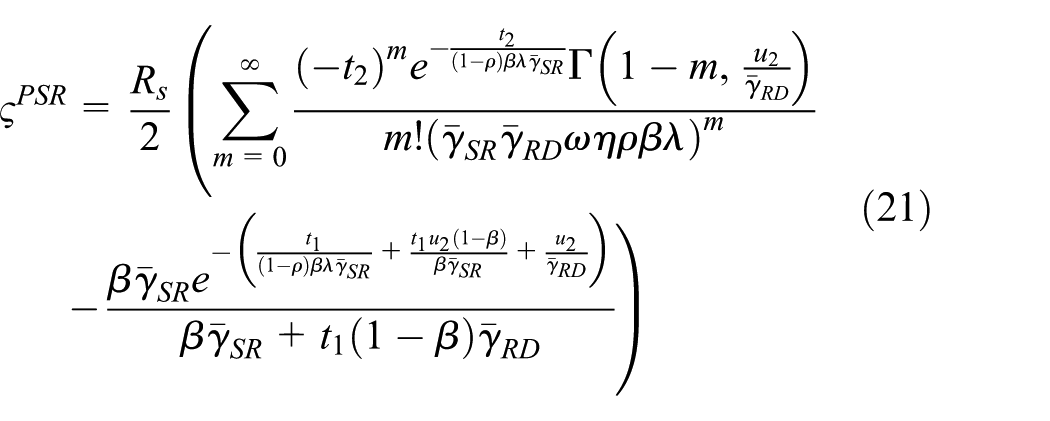
From equations (18) and (19), we find that the SOP and COP of the PSR strategy are not mutually exclusive as the TSR strategy. In order to assess the tradeoff between reliability and security of the PSR strategy, the EST is given by
and the exact EST expression of the PSR strategy is given by the following proposition.
Proposition 2
The exact EST expression of the PSR strategy can be expressed as
where , and , , .
Proof
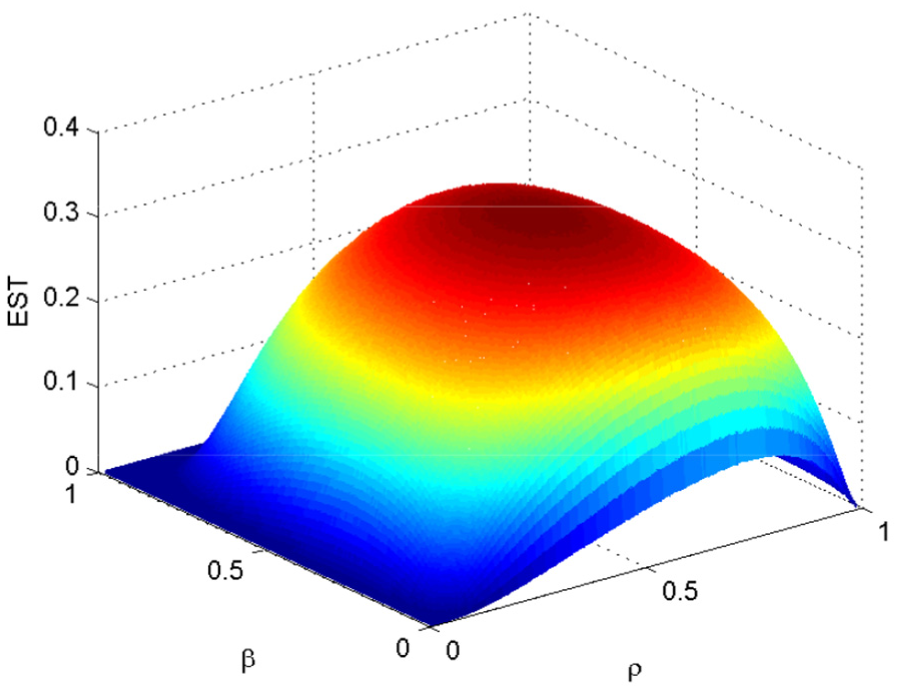
The desired result of (21) can be easily derived by following the similar analysis as Proposition 1. From equations (18)–(20), we know that increasing leads to the reliability improvement while the security degradation and thus existing an optimal value of makes the EST performance maximization. In addition, the power splitting ratio can be optimized to maximize the EST. Therefore, the optimal and are the solutions to the optimization problem of . However, the optimizing problem cannot give an exact expressions of the optimal and due to the high complexity of the involved expression. We can focus on jointly optimizing the and by numerical searching methods as shown in Figure 8.
IRR strategy
In this section, the IRR which harvests power and processes the transmission information signal simultaneously and independently from the same received signal is investigated (It is worth mentioning that this strategy may not hold in practice due to the current circuit limitation. However, the results provide performance upper bounds, which can be regard as a benchmark for comparison purposes.). Therefore, in the first phase, , the relay extracts power and processes information from the received signal. During the second phase, the relay amplifies and forwards the received signal with the harvested energy.
Energy harvesting and signal processing
As mentioned above, the harvested energy and relay transmitted power of IRR strategy are respectively given by
and
The received signal at the relay in the first phase is given by
The received signal at the destination in the second phase is given by
Secure transmission performance
According to equations (2) and (24), the mutual information of the relay under the IRR strategy is the same as the TSR strategy. Therefore, the SOP of the IRR strategy can be expressed as equation (9), which indicates that the TSR and IRR strategies have the identical security performance.
According to equation (25), the mutual information of the destination, , is given by (26). Thus, the COP of the IRR strategy is given by
In the following, as the TSR and PSR strategy, the EST of the IRR strategy used to measure the tradeoff between reliability and security is given by
and the exact EST of the IRR strategy is provided by the following proposition.
Proposition 3
The exact EST of the IRR strategy can be expressed as
where , and , , .
Proof
The desired result of (29) can be easily derived by following the same steps as Proposition 1.
Unlike the TSR and PSR strategy, where the selections of and are very important for the EST performance, the EST of the IRR strategy can only be maximized by the optimal power allocation factor .
Asymptotic performance analysis
In this section, we focus on an asymptotic analysis of the EST and elicit the optimal energy harvesting strategies for different channel gains and power budgets. Based on the expressions of equations (12), (21), and (29), we conduct the asymptotic analysis of the EST for the three energy harvesting strategies, that is, TSR strategy, PSR strategy, and IRR strategy
Let denote the transmit SNR. Case of transmit SNR, : From equation (12), we know that
For IRR strategy, according to equation (29), we have
Remark 1
We can see that the EST of the TSR and PSR strategies converges to different constants. Moreover, it can be inferred from equations (30) and (31) that when transmit power is sufficiently large, the PSR strategy strictly outperforms the TSR strategy in terms of their EST performance. In addition, in the high-transmit power regime, the EST performance of the PSR strategy is the same as the IRR strategy, which indicates the advantage of the PSR strategy in the high SNR condition.
2. Case of : From equation (12) and using the result that as , we have
where the EST, , in equation (33) depends on , , , , , and . According to equation (21) and following the same steps as the TSR strategy, the EST of the PSR strategy will converge to
where the EST, , in equation (34) depends on , , , , , and . Similarly, for the IRR strategy, the EST will converge to a constant given by
Remark 2
Based on equations (33) and (34), we can see that a switching threshold of transmit power is for the TSR and PSR strategies, when the destination is very close to the relay. In other words, when the transmit power is greater than the threshold value, the PSR can achieve a better EST performance than the TSR strategy. Conversely, the EST of the TSR strategy is better than the PSR strategy when the transmit power is less than the threshold value. This conclusion is consistent with the simulation results in Figure 3.
Numerical results
In this section, we verify the accuracy of the analytical expressions by Monte Carlo simulation. Unless otherwise stated, we set the codeword transmission rate, , the confidential information rate . Also, the energy harvesting efficiency is set to be , and is set to be .
Figure 2 shows the COP and SOP versus the transmit SNR of the TSR strategy as well as the PSR and IRR strategies, where , , , , and . The first observation one can seen from Figure 2 is that the derived analytical results match well with simulation results. Besides, some observations can be drawn as follows: (1) the SOP of the TSR, PS,R and IRR strategies increases accordingly with the transmit power increasing, whereas the corresponding COP of the three strategies reduces. The reason is that as the transmit power increases, the relay and destination can gain more information. Thus, there exists a security and reliability tradeoff between SOP and COP in untrusted energy harvesting relay networks. (2) The SOP of the three strategies approaches to a constant less than unity in the high-transmit power regime. This is due to the fact that the jamming signal sent by the destination guarantees the security of the three transmission strategies at this time.
The outage probability of the three strategies versus SNR.
Figure 3 depicts the EST as a function of the transmit SNR, where , , , , and . As we can readily observe that the closed-form analytical approximation results of equations (12), (21), and (29) provide a very good approximation to the exact simulation results. This figure shows that (1) the EST approaches to a constant for the TSR, PSR, and IRR strategies when . This is because that the EST is constrained by the confidential information rate in the high SNR regime. (2) In the high SNR region, the PSR strategy strictly performs better than the TSR strategy in terms of the EST performance. This is due to the fact that the effective communication time of TSR strategy is less than the PSR strategy at this time. (3) The switching threshold between TSR and PSR strategies can effectively distinguish the optimal energy harvesting strategies for different power budgets.
The EST of the three strategies versus SNR.
Figure 4 examines the impact of power allocation factor on the EST performance, where , , , , and . For the three relaying strategies, the EST first increases with the power allocation factor increasing and then begins to decrease when beyond a certain value. This is very obvious, according to equations (12) and (21); when is small, the throughput is small; when is large, the security cannot be guaranteed, which again degrades the throughput. Thus, for a particular time switching factor and power splitting ratio, there exists a unique power allocation factor which leads to maximizing the throughput. Although a closed-form solution for the optimal power allocation factor is intractable due to the complexity of the throughput expressions, the solution can be obtained offline by numerical searching methods, for example, the grid-search method.
The EST of the three strategies versus .
Figure 5 illustrates the EST of the three strategies as a function of the , with , , , , . The results show that the EST increases to a peak value and then decreases as a function of . This phenomenon can be explained as follows. When , the untrusted relay and the source are too close to make the secure transmission impossible, and therefore, the EST is low. When , a reliable transmission cannot be afforded without the direct link, which also has a negative effect on the EST. Moreover, the EST of the PSR strategy is consistent with the IRR strategy when is large. The reason for this is that the probability of a successful transmission is independent of the power splitting ratio at this moment.
The EST of the three strategies versus .
Figure 6 plots the EST of the three strategies as a function of , with , , , , . It can be seen from the figure that there exists floors and ceilings of the EST for the three strategies. This is because when goes to infinity, the probability of a successful transmission approaches to a constant, and therefore, the EST is mainly dependent on the confidential information rate. In addition, the EST performance of the IRR strategy outperforms the TSR and PSR strategies for different .
The EST of the three strategies versus .
To further evaluate the effect of power allocation factor and time switching factor on the secrecy throughput, Figure 7 plots the EST versus and for the TSR strategy, where , , . It is clearly observed that subject to a fixed , the EST increases to a peak value as reaches its optimal value and then starts decreasing for large values of . This behavior can be explained as follows. When is small, less energy is harvested at the relay for information transmission, which leads to larger COP. While the effective communication time between the source and the destination is not sufficient when more time is used for energy harvesting, which also leads to poor EST. On the other hand, given a fixed , the EST is also a concave function of . These conclusions motivate the system designer to carefully take into account the time switching factor and power sharing between source and destination.
The EST versus and for the TSR strategy.
The achievable EST for the PSR strategy versus and is also illustrated in Figure 8, where , , . It is intuitive that the EST increases as increases from 0 to an optimal , but later, it begins to decay along with increasing from the optimal value when a fixed is given. Similar to the TSR strategy, less power is available at the relay for the information transmission when is small, which results in larger COP. On the other hand, when is large, the relay amplifies and forwards poor signal strength to the destination, and hence, smaller value of the EST is observed due to larger COP. As well, given a fixed , an optimal value of exists to maximize the EST. Therefore, the optimal power splitting ratio and power allocation factor can be chosen to maximize the EST.
The EST of versus and for the PSR strategy.
Conclusion
In this article, we investigated the wireless energy harvesting and information processing protocol in a half-duplex AF untrusted relay network over Rayleigh fading channels. Considering the TSR, PSR, and IRR strategies, the exact analytical expressions of the SOP, COP, and EST were respectively derived for the secure transmission system, which quantitatively reveal the relationship between the system performances and the time switching factor, power splitting ratio, as well as other various parameters. Then, the asymptotic analysis of the EST was studied to determine the optimal energy harvesting strategies under different operating regimes. Finally, the switching threshold of transmit power between TSR and PSR was given. Analytical and numerical results provided that the PSR strategy performs better than the TSR strategy when the transmit power is larger than threshold. While the TSR strategy is superior to the PSR strategy when the transmit power is less than threshold.
Footnotes
Handling Editor: Yanping Zhang
Declaration of conflicting interests
The author(s) declared no potential conflicts of interest with respect to the research,authorship,and/or publication of this article.
Funding
The author(s) disclosed receipt of the following financial support for the research,authorship,and/or publication of this article: The work by Dechuan Chen,Weiwei Yang,Jianwei Hu,Weifeng Mou,and Yueming Cai was supported by the National Natural Science Foundation of China (no. 61471393,no. 61771487,and no. 61501512),Jiangsu Provincial National Science Foundation (BK20150718) and China Postdoctoral Science Foundation under a Special Financial Grant (no. 2013T60912).
References
1.
KuMLLiWChenYet al. Advances in energy harvesting communications: past, present, and future challenges. IEEE Commun Surv Tut2016; 18(2): 1384–1412.
2.
DingZZhongCNgDWKet al. Application of smart antenna technologies in simultaneous wireless information and power transfer. IEEE Commun Mag2015; 53(4): 86–93.
3.
UlukusSYenerAErkipEet al. Energy harvesting wireless communications: a review of recent advances. IEEE J Sel Area Comm2015; 32(3): 360–381.
4.
VarshneyLR. Transporting information and energy simultaneously. In: IEEE international symposium on information theory, Toronto, ON, Canada, 6–11 July 2008. New York: IEEE.
5.
GroverPSahaiA. Shannon meets Tesla: wireless information and power transfer. In: IEEE international symposium on information theory, Austin, TX, 13–18 June 2010. New York: IEEE.
6.
NasirAAZhouXDurraniSet al. Relaying protocols for wireless energy harvesting and information processing. IEEE T Wirel Commun2013; 12(7): 3622–3636.
7.
ZhongCSuraweeraHAZhengGet al. Wireless information and power transfer with full duplex relaying. IEEE T Commun2014; 62(10): 3447–3461.
8.
ZhouZPengMZhaoZet al. Joint power splitting and antenna selection in energy harvesting relay channels. IEEE Signal Proc Let2015; 22(7): 823–827.
9.
YangZDingZFanPet al. Outage performance of cognitive relay networks with wireless information and power transfer. IEEE T Veh Technol2016; 65(5): 3828–3833.
10.
HeXYenerA. Cooperation with an untrusted relay: a secrecy perspective. IEEE T Inform Theory2010; 56(8): 3807–3827.
11.
JeongCKimIMKimDI. Joint secure beamforming design at the source and the relay for an amplify-and-forward MIMO untrusted relay system. IEEE T Signal Proces2012; 60(1): 310–325.
12.
HuangJMukherjeeASwindlehurstA. Secure communication via an untrusted non-regenerative relay in fading channels. IEEE T Signal Proces2013; 61(10): 2536–2550.
13.
MoJTaoMLiuYet al. Secure beamforming for MIMO two-way communications with an untrusted relay. IEEE T Signal Proces2014; 62(9): 2185–2199.
14.
SunLRenPDuQet al. Security-aware relaying scheme for cooperative networks with untrusted relay nodes. IEEE Commun Lett2015; 19(3): 463–466.
15.
XuHSunLRenPet al. Securing two-way cooperative systems with an untrusted relay: a constellation-rotation aided approach. IEEE Commun Lett2015; 19(12): 2270–2273.
16.
ZhaoMWangXFengS. Joint power splitting and secure beamforming design in the multiple non-regenerative wireless-powered relay networks. IEEE Commun Lett2015; 19(9): 1540–1543.
17.
KalamkarSSBanerjeeA. Secure communication via a wireless energy harvesting untrusted relay. IEEE T Veh Technol2017; 66(3): 2199–2213.
18.
WangLCaiYZouYet al. Joint relay and jammer selection improves the physical layer security in the face of CSI feedback delays. IEEE T Veh Technol2016; 65(8): 6259–6274.
19.
WangZChenZXiaBet al. Cognitive relay networks with energy harvesting and information transfer: design, analysis, and optimization. IEEE T Wirel Commun2016; 15(4): 2562–2576.
20.
DingZPerlazaSMEsnaolaIet al. Power allocation strategies in energy harvesting wireless cooperative networks. IEEE T Wirel Commun2014; 13(2): 846–860.
21.
GradshteynISRyzhikIM. Tables of integrals, series, and products. 7th ed.Burlington, MA: Academic Press, 2007.