







Abstract
Keywords
Introduction
At present, Internet of Things (IoT) is one of the most powerful communication standards of the 21st century. In the IoT environment, all electronic devices in our daily life will be part of the Internet due to their communication and computing capabilities. IoT spreads the concept of the Internet, making it universal. IoT enables all-in-one communication among various kinds of electronic devices. Subsequently, IoT has become more creative in some fields, for example, healthcare technology. In healthcare technology, IoT involves numerous types of inexpensive sensors, wearable and implanted, that allow the elderly to enjoy current medical healthcare services anywhere and anytime, improving their quality of life.1–4
Wireless body sensor network (WBSN) technologies are one of the most powerful technologies that could be utilised in the IoT-based modern healthcare paradigm. 5 WBSN technology is a group of low-power and lightweight devices with a transceiver which is used to observe the vital signs of the human body. Every sensor in the WBSN can gather physiological signals such as electrocardiogram (ECG), electroencephalogram (EEG) and forward these signals to the coordinator node (CN) over a wireless medium or human body channel (HBC) for further analysis and inspection. 6 WBSN paradigms are capable of giving long-range healthcare monitoring without constraining a person’s mobility or activity. These paradigms are used to create intelligent and inexpensive healthcare monitoring to be used for the diagnostic procedure. 7 However, the performance of WBSN systems is profoundly affected by the limited energy of sensors and coordinators. The recent advances in energy harvesting (EH) techniques allow sensors on the human body to gain various kinds of energy. Various power recharging techniques have been investigated and developed recently, such as wind power, solar power and thermoelectric energy. One of the most suitable techniques for a WBSN system to harvest energy is radio frequency–based energy harvesting (RF-EH).8,9 For RF-EH, the received radio signals are transformed into DC power, then stored in the battery. 10
Related work
Despite its widespread emergence, IoT is still in its infancy and requires research in various issues such as standards, scalability, heterogeneity, common service description language, domain-specific service discovery and integration with existing IT systems. In this section, we describe the current state of the art of an IoT health-based paradigm.
The IoT for health-based system has been surveyed by Ghamari et al. 11 and Yuehong et al., 12 where, in Ghamari et al., 11 a review of the current research in the area of WBSNs with a specific focus on low-power consumption, transmission reliability, latency, data rates and security is presented and discovered. In addition, the authors consider the necessities and issues of WBSN in a traditional eHealthcare paradigm in order to discover how such paradigms are capable of communicating with the home network efficiently. The applications of IoT in the healthcare industry are surveyed and inspected by Yuehong et al., 12 and they identify the intelligentisation trend of future research in the e-healthcare IoT-based paradigms.
Security is one of the major challenges of the IoT health because the WBSN sensors are utilised to gather life-critical data and may operate in hostile environments; therefore, they need strict security techniques to prevent malicious interaction with the system. In literature, there have been several works on the security of IoT health-based paradigm, for example, a secure IoT healthcare-based paradigm that operates over the WBSN was introduced by Yeh. 13 Where, he proposed a reliable crypto-primitive that was used to build double communication techniques, guarantee transmission privacy and create entity authentication over sensors, CNs and the edge of the network (server). Consider a new structure of the e-healthcare IoT-based paradigm; a secure e-healthcare IoT-based paradigm utilising body sensor network (BSN)-care. Moosavi et al. 14 proposed an end-to-end security system for a non-static e-healthcare IoT-based paradigm. In their analysis, they apply the concept of fog-computing in IoT for realising seamless mobility due to the fog-extended cloud system at the edge of the network. Luo et al. 15 proposed a privacy protector that protects patients’ gathered data. The Slepian–Wolf coding-based secret sharing is utilised in PrivacyProtector which overcomes many types of security techniques such as secret keys for encryption and authentication, message-authentication codes, the public-key cryptosystem and k-anonymity. The privacy and security concerns with healthcare data acquisition and then transmission are studied by Tao et al. 16 Then, the authors proposed a secure data-collection scheme for the IoT-based healthcare system named SecureData. A privacy-preserving chaos-based encryption cryptosystem for patients’ privacy protection was designed by Hamza et al. 17 The cryptosystem can protect patient’s images from a compromised broker. The medical data was processed without leaking any information, thus preserving the patient’s privacy by allowing only authorised users for decryption. A hybrid security model for securing the diagnostic text data in medical images in IoT health-based system is proposed by Elhoseny et al. 18 The proposed hybrid encryption schema is built using a combination of Advanced Encryption Standard and Rivest, Shamir and Adleman algorithms. The proposed model is developed by integrating either two-dimensional (2D) discrete wavelet transform 1 level (2D-DWT-1L) or 2D discrete wavelet transform 2 level (2D-DWT-2L) steganography technique with a proposed hybrid encryption scheme.
Generally, the IoT health-based system comprises several layers, and some research considers the first layer to improve and make sure data delivered efficiently, where, Alkhayyat et al. 19 proposed the IoT health base application. The authors designed the IoT with five layers; each stage processes the data and transfers them to the next layer. They believe that, by improving the quality of the information at the first layer, the decision at last layer could be selected properly. Liao et al. 20 provided an accurate statistical in-body to off-body channel model, which described the signal propagation between the antenna’s transceiver based on three-dimensional (3D) virtual human body model. Catarinucci et al. 21 considered and investigated the impact of a power control and packet-size selection over wireless medium on the performance of e-healthcare IoT-based paradigms. In their study, they proposed three different protocols: power-level decisions; a power-level and packet-size decision; and a global link decision. A novel IoT-aware smart hospital system is designed and studied by Chen et al. 22 The proposed paradigms are capable of managing emergency conditions appropriately. Interoperability remained a significant burden to the researcher and developers of the IoT scheme. Aktas et al. 23 proposed an energy-aware system. They have designed a new IoT-based healthcare framework associated with WBANs and RFID technologies built for hospital information systems.
Cloud computing (CC) for IoT has emerged as a new platform in the 21st century. Darwish et al. 24 established a new concept between CC and IoT named as Cloud IoT-Health (CC-IoT) paradigm. The term CC-IoT and several key integration challenges are considered to show a practical vision that integrates current mechanisms of CC and IoT in healthcare applications. A type-2 fuzzy ontology–aided recommendation system for IoT-based healthcare to efficiently monitor the patient’s body is proposed by Ali et al. 25 Then, type-2 fuzzy logic and fuzzy ontology are combined, which improved better accuracy rate for predicting a patient’s situation and suggesting medicine and nutrition. As a result, Jabbar et al. 26 proposed an IoT-based semantic interoperability model, which provides semantic interoperability over heterogeneous IoT devices. Physicians communicate with their patients, and the information between them is semantically annotated and communicated in a meaningful way.
Wu et al. 27 assumed the on-body sensors device embedded with solar EH module for the autonomous WBSN; the application is designed and analysed. In addition, a Web-based smartphone application is developed for showing the information gathered. As mentioned previously, there was no research that integrated the Internet of the medical thing with EH; however, Wu et al. 27 assumed that the energy is harvested through solar system which is infeasible and not practical for sensors attached to the human body due to their small size and might be located under the clothes or skin. In addition, we used several energy harvesters rather than a single energy harvester (i.e. solar energy harvester), which eliminates the concept of single point of failure (SPOF). A comparison of the state-of-the-art work is also shown in Table 1.
Comparison of state of art work.

BSN: body sensor network; BLE: Bluetooth low energy; WBAN: wireless body area network; WBSN: wireless body sensor network.
The contribution of this work can be summarised as follows:
An IoT health-based paradigm is designed, which describes the journey of data from the human body to the health cloud over four different tiers.
We consider the inter-WBSN cooperation with EH, where co-located WBSNs cooperate and harvest energy during a dedicated time slot from the external energy-harvester devices.
In this work, three protocols are designed and investigated along with an EH technique. We name and abbreviate the protocols as energy harvesting–based dual-hop cooperation (EH-DH), energy harvesting–based inter-WBSN cooperation (EH-IWC) and energy harvesting–based incremental inter-WBSN cooperation (EH-IIWC).
An explicit mathematical expression of the outage probability for EH-DH, EH-IWC and EH-IIWC is described, based on the IoT health-based paradigm.
We reveal that the proposed EH-IIWC protocol achieves better performance in terms of outage probability over EH-IWC and EH-DH in an IoT health-based paradigm.
The rest of the article is organised as follows: WBSN network architectures are described in section ‘WBSN networks architecture’, which includes two sub-sections, ‘WBSN in IoT-based health network’ and new inter-WBSN cooperation as well as the basic operation of the proposed protocols. In section ‘Link and outage probability analysis’, the link analysis and outage probability of the direct transmission and proposed protocol are inspected. The energy efficiency of the different transmission scenarios and proposed protocols and the performance and results are investigated in section ‘Simulation and results’. Finally, the conclusion and future work are drawn in section ‘Conclusion’.
WBSN networks architecture
WBSN in IoT-based health network
A new architecture of an IoT health-based paradigm is shown in Figure 1, which can be divided into four tiers. Every tier of this proposed architecture is additionally clarified in more detail as follows:
The WBSN tier (Tier#1): in this tier, the sensors might be attached directly to the human body, sewn into fabric (wearable sensors) or implanted inside the human body. Examples of such sensors are EEG, ECG and EMG. The data recorded via sensors are transmitted to the CN via wireless 802.15.6 standard; the CN then transfers what was transmitted by the sensors to the next tier over the wireless technology or cables.
Bridge tier (Tier#2): in this tier, data are transferred from the CN to Tier#3 using one of the selected wireless communication technologies (i.e. Bluetooth, Wi-Fi or cellular base-station) or smart devices (i.e. smartphone, laptop or tablet). Tier#2 represents the bridge tier that connects the WBSN to the infrastructure Internet, and Tier#2 devices either located indoors or outdoors. The information gathered from this tier should be moved to Tier#3 in order to be ready for the edge network.
Infrastructure Internet tier (Tier#3): this level bridges the gap between the Tier#2 and Tier#4 via existing wireless technology.
Health-Cloud tier (Tier#4): in this tier, the received data take three possible paths:
Database: this consists of three sub-levels, such as suggested food and nutrition, tips and medicine for the specific disease.
Storage: this saves the data and the information of the patient and their doctors’ information.
Intelligent healthcare server: this is the most crucial part; at this level, the data are analysed to make a proper decision. The intelligent healthcare server may include one of the four possible sub-levels, such as doctors or hospitals, emergency or intermediate family.

WBSN in proposed IoT-based health paradigm.
It is clear from the above discussion, determining a proper medicine and services are entirely dependent on received data from the first tier; if incorrect or damaged data is received from the first tier, the decision at the last tier might be hazardous to the life of the patient. Therefore, we proposed a new protocol to ensure and enhance data delivery to the third stage.
Proposed protocols description
In the traditional WBSN network architecture, many sensors are evenly spread over the human body to observe important vital signs, and each sensor gathers and transmits the data to the CN. Thus, a WBSN is based on the single-hop star topology; all the sensors transmit their gathered data over a wireless medium or HBC to the CN. The CN then sends the data to the next tier as previously explained. The topology of the inter-WBSN is shown in the Figure 2.
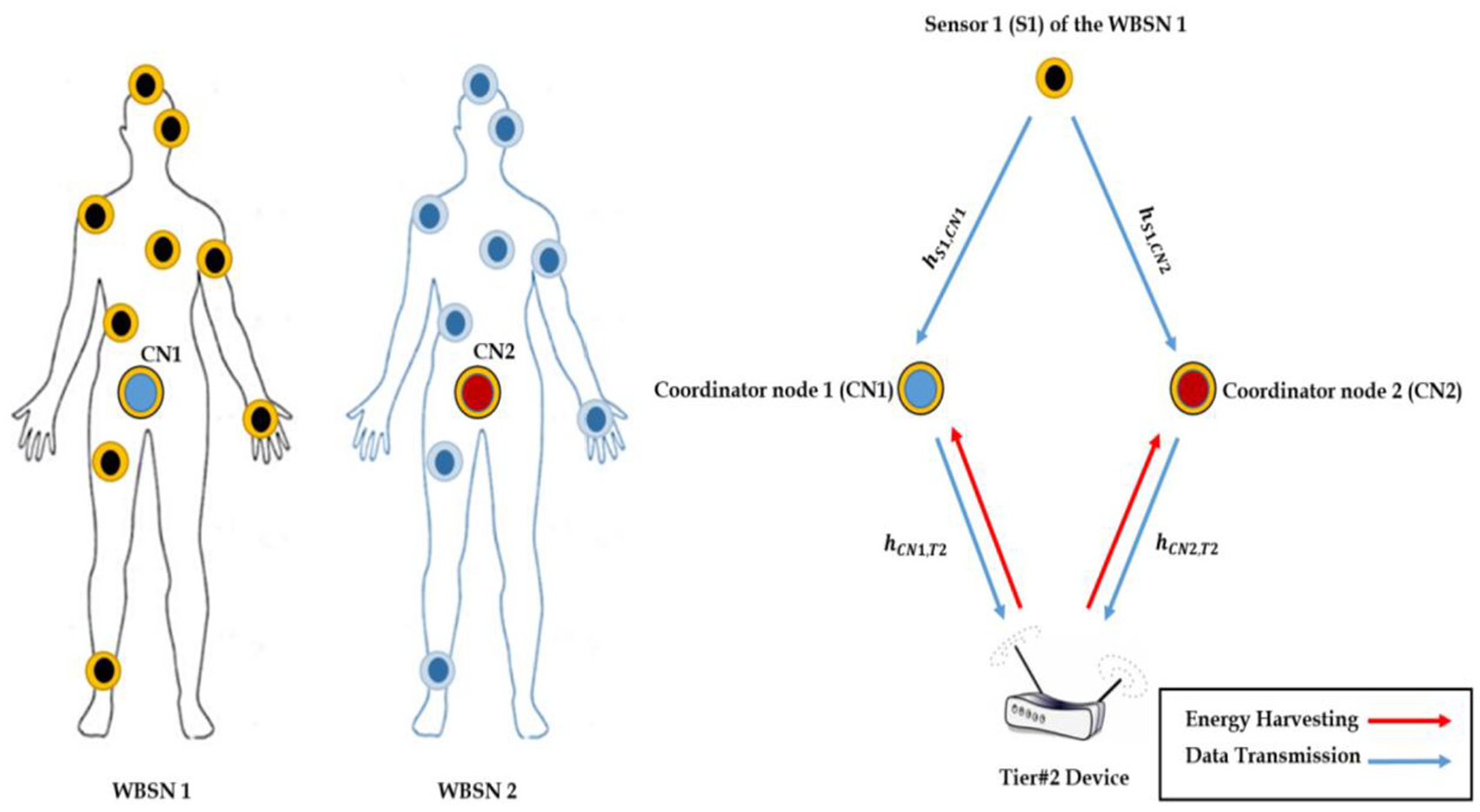
Inter-WBSN cooperation topology.
With WBSNs, sensors are placed on the body, below the skin tissue a few millimetres or implanted in the body; however, this makes replacing their batteries impractical. EH technology through RF is a good candidate for overcoming this problem, enabling sensors around the human body to replenish their batteries with energy. Based on the traditional WBSN network, we propose and design three protocols in this article.
The first protocol is EH-DH, and works as follows: in the first phase, the on-body sensors gather the data from the body and transmit it to the CN1 over a wireless medium, the CN1 then processes the received data, and it transmits back positive acknowledgement signal (ACK). In the second phase, the CN1 requests energy from the T2 device, and then the T2 device transmits energy via RF at the time. In the third phase, and at the time
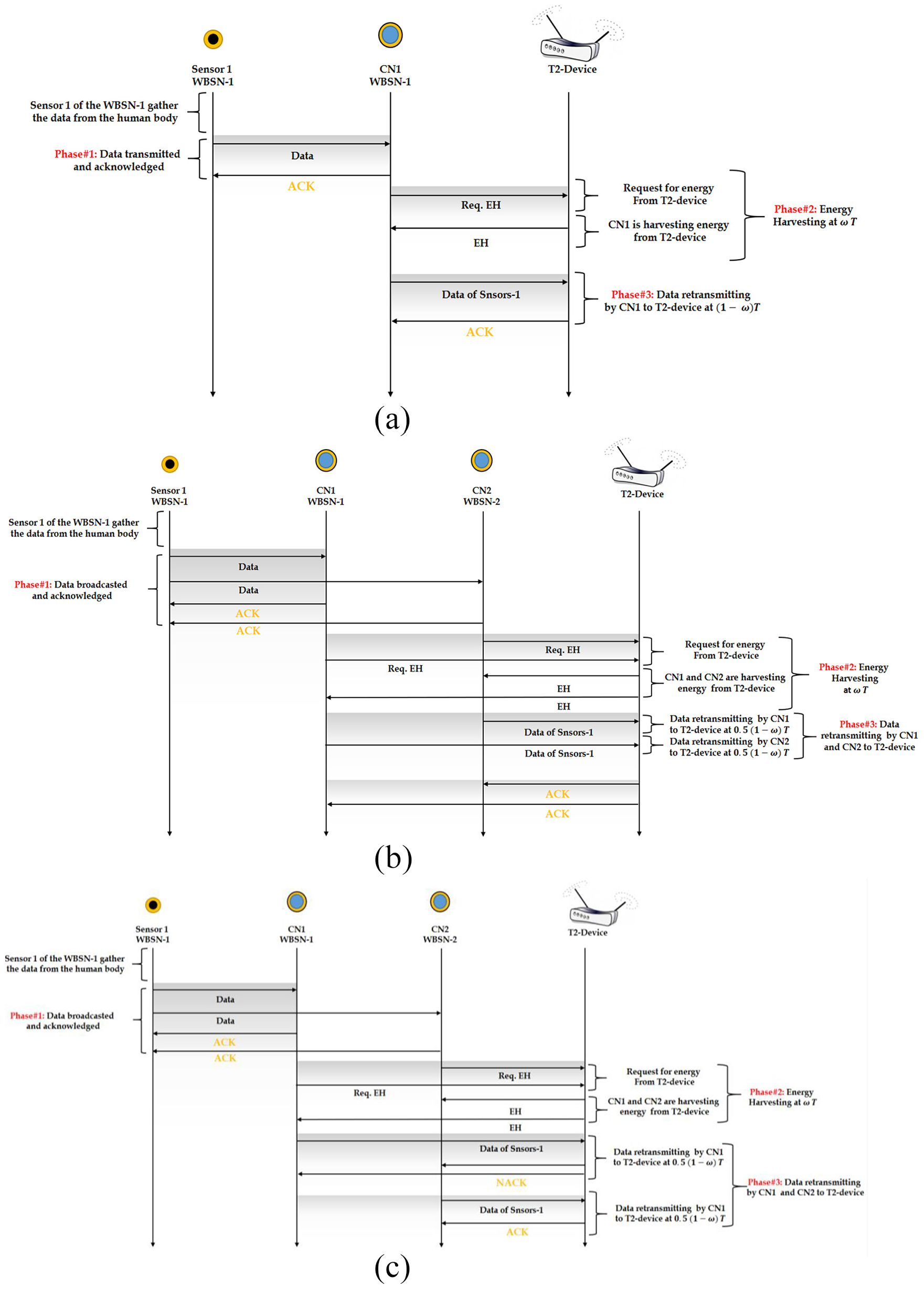
Overall sequences of the proposed protocols: (a) overall sequence of energy harvesting–based dual-hop cooperation (EH-DH), (b) overall sequence of energy harvesting–based inter-WBSN cooperation (EH-IWC) and (c) overall sequence of energy harvesting–based incremental inter-WBSN cooperation (EH-IIWC).
The second protocol is EH-IWC and works as follows: in the first phase, the on-body sensors gather the data from the body and transmit (broadcast) it to the CN1 and CN2 over the wireless medium. The CN1 and CN2 then process the received data and transmit back positive ACK. In the second phase, the CN1 and CN2 request energy from the T2 device, and then the T2 device transmits energy via RF at time
The last protocol is EH-IIWC and works as follows: in the first phase, the on-body sensors gather the data from the body and transmit (broadcast) it to the CN1 and CN2 over the wireless medium; the CN1 and CN2 then process the received data and transmit back positive ACK. In the second phase, the CN1 and CN2 request energy from the T2 device, and then the T2 device transmits energy via RF at the time
Link and outage probability analysis
In this section, the propagation model and the outage probability between two nodes are described. Where the average signal-to-noise ratio

where

where

where

where

Outage probabilities analysis of proposed protocols
In this sub-section, the outage probability of the EH-IIWC is investigated and analysed which consequently leads to the outage probability of the EH-DH and EH-IWC. As shown in Figure 2 and described previously, the outage probability of the EH-IIWC is mathematically expressed as

where

where

where


then,


In a sequel, the second phase is the EH phase (in this phase, we assumed the channel is deterministic); the T2 device will transmit RF power to harvest energy to the CN1 and CN2 nodes at

where

According to equation (14), we define


then, utilising equations (14)–(16), the


then,


Substituting equation (9)–(11) and equations (17)–(20) in equation (8), we obtain
Simulation and results
In this section, we evaluate the performance of the proposed Inter-WBSN cooperation of IoT health-based systems via computer simulations. In the simulations, a random topology, various wireless body sensors are located in a range of 3 m × 3 m, and two human bodies are assumed to be co-located in the same range. The distances are assumed to be variable in the simulations, and all links are assumed to have the same distance which is denoted as
Figure 4 shows the comparison of outage probability for three different protocols as a function of the internode distance,
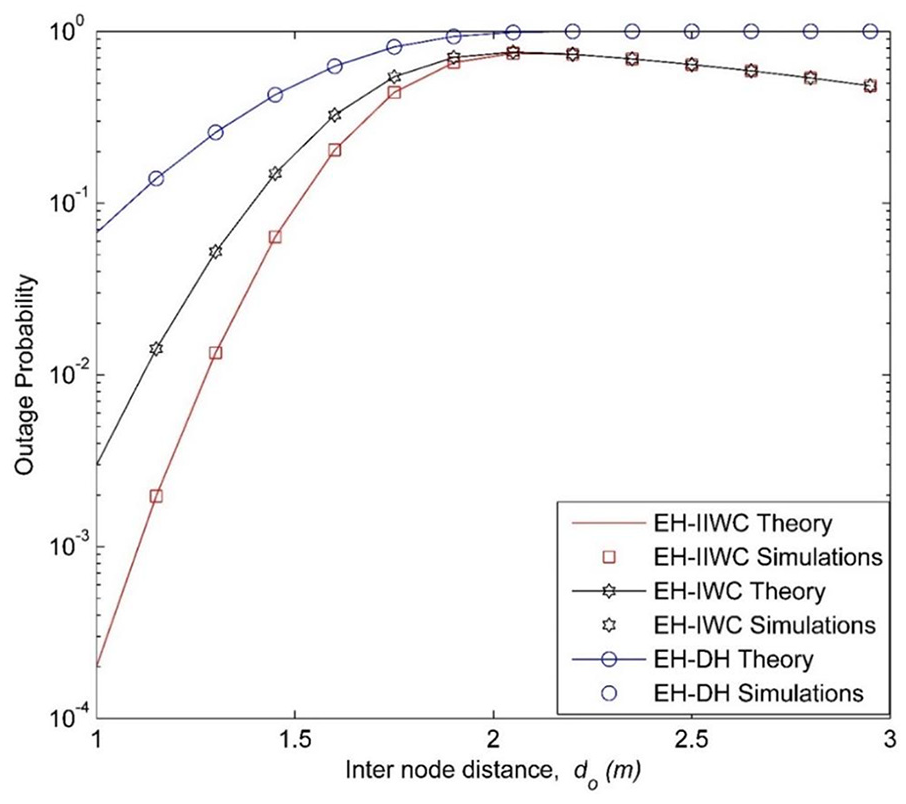
Outage probability versus internode distance,
Figure 5 shows the comparison of outage probability for three different protocols as a function of fraction time for EH and data transmission,

Outage probability versus
Figures 6 and 7 show the comparison of outage probability for three different protocols as a function of interferer nodes,

Outage probability versus number of interferer nodes,
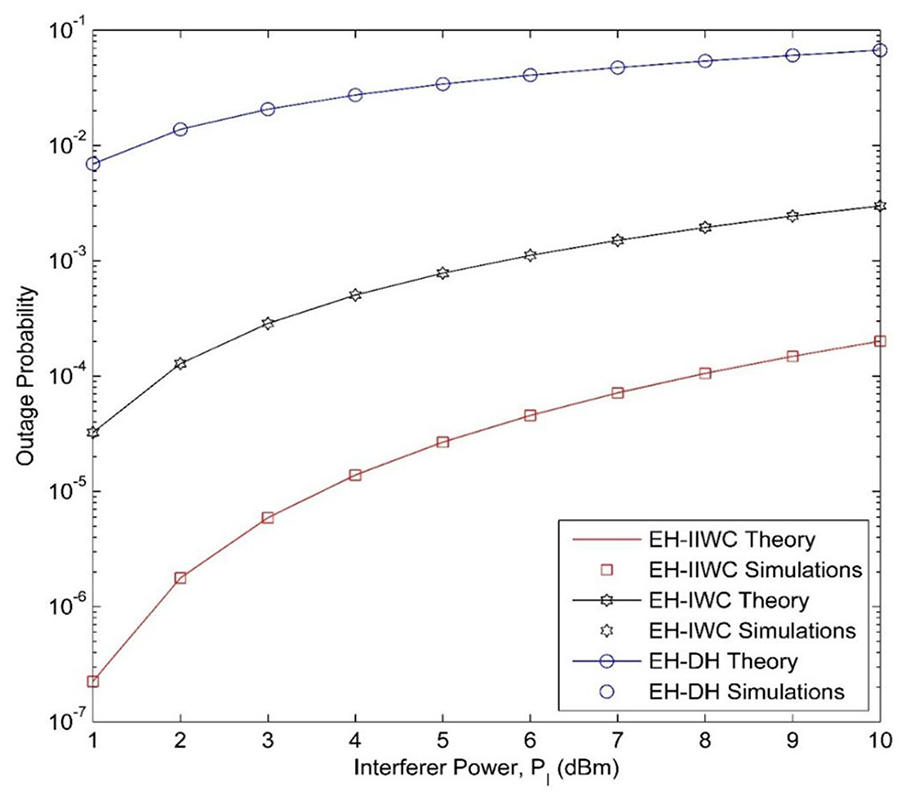
Outage probability versus interferer transmission power,
Finally, Figure 8 shows the comparison of outage probability for three different protocols as a function transmission power of all the source,
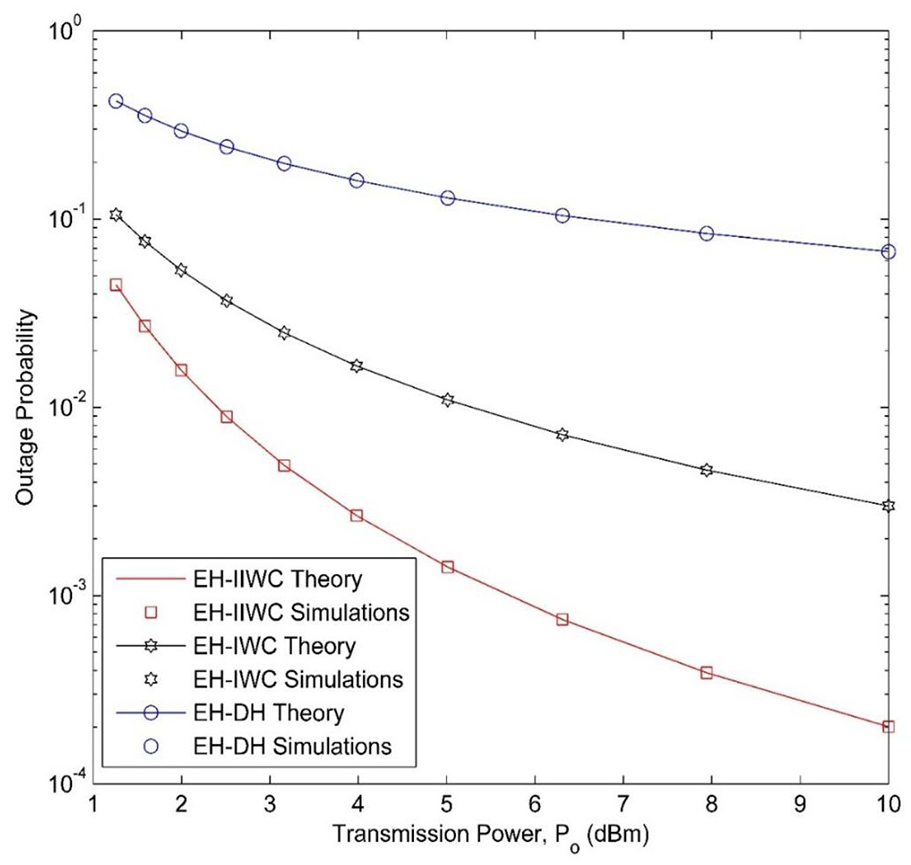
Outage probability versus transmission power,
One of the major results of this article is that an EH-IIWC protocol achieves a better performance than EH-IWC and EH-DH in the general circumstance, while EH-IWC is better than EH-DH. However, EH-IIWC and EH-IWC require multiple WBSNs co-located in the same area (transmission range), which is expected in real environments in the near future. We can conclude that EH-IIWC and EH-IWC are better than EH-DH when there are many WBSNs distributed in the same range protocol in a real WBSN environment.
Conclusion
Recent advances in the design of IoT technologies are spurring the development of smart systems that support and improve healthcare. In this article, we have designed a new paradigm of the IoT health-based system. In the proposed design, we have improved the system performance over the physical layer within the human body range and beyond. The outage probabilities for three different protocols with EH are derived and formulated. The results show that the EH-IIWC achieved a better performance compared to the EH-IWC and EH-DH in terms of the outage probability, while the EH-IWC has outperformed the EH-DH in terms of the outage probability.
In future work, we will analyse the proposed protocol with the EH technique for different data traffic, such as critical and non-critical traffic.
Footnotes
Declaration of conflicting interests
Funding
ORCID iD
